What does a pressure regulator do?
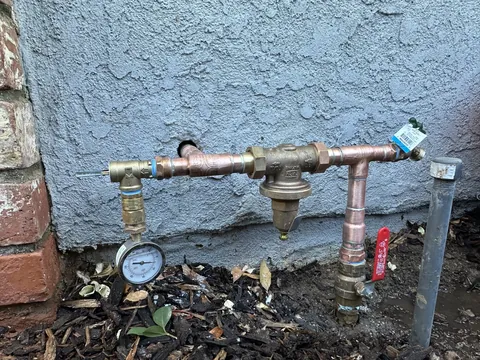
It takes whatever pressure the water main delivers and lowers it to a steady level for the house. San Bernardino's water department describes it as a dome-shaped brass fitting, usually at the front of the property, in the garage, or on the pipe feeding an outside hose bib.
Source: San Bernardino Municipal Water Department, Water Pressure. Checked October 17, 2026.
When is one required?
LADWP says new residential plumbing in the City of Los Angeles needs a pressure regulator wherever the pressure from the city main can exceed 80 psi, a requirement LADBS enforces.
San Bernardino's water department points to the same California Plumbing Code requirement for areas where pressure is high enough to damage fixtures and appliances.
Sources: LADWP, Water Pressure; San Bernardino Municipal Water Department, Water Pressure. Checked October 17, 2026.
Is the regulator mine or the water company's?
Yours. LADWP says the homeowner installs and maintains it, and San Bernardino's water department says it doesn't install or maintain them.
LADWP also notes that older homes may not have one at all.
Sources: LADWP, Water Pressure; San Bernardino Municipal Water Department, Water Pressure. Checked October 17, 2026.
How do I know mine is failing?
A failing regulator usually lets more pressure through, not less. The signs are banging pipes when a valve closes, a toilet that refills on its own, a water heater relief valve that drips, and supply hoses under sinks that fail long before they should.
How do I test my water pressure?
Buy a pressure gauge that threads onto a hose bib; any hardware store has them. Screw it onto the spigot nearest the regulator, open it fully with nothing else running in the house, and read the needle. If it's above 80 psi, the regulator isn't doing its job. Check again at night, when pressure in the main often rises.
Why the water heater cares
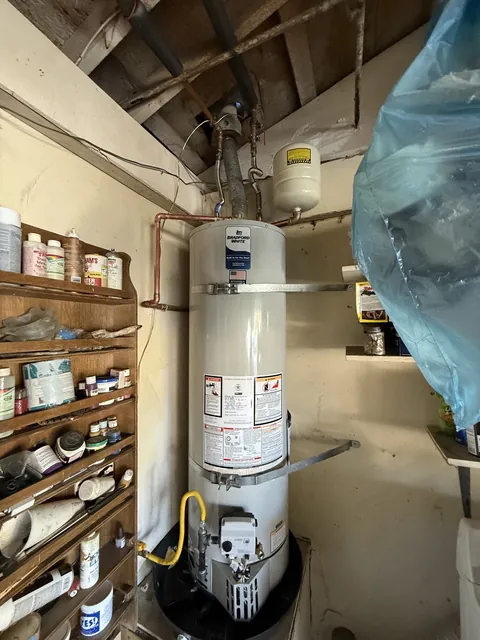
A regulator stops water from flowing back toward the street. When the water heater warms a tank of water, that water expands, and with nowhere to go the pressure climbs. An expansion tank on the heater's cold line gives it room. When we replace a regulator, we look for one.